website
Left Continue shopping
Your Order

You have no items in your cart

You might like
$16.80 $18.00

「元正」紅茶・ローヤル ブラクティ スモーク型 正山小種(ラプサンスーチョン)

$38.00 USD
Tax included. Shipping calculated at checkout.
Description
This tea is harvested at an altitude of over 800 meters within the Wuyi Mountain National Nature Reserve, crafted using the authentic traditional Lapsang Souchong techniques. It delivers distinct smoky notes and classic pine‑smoke aroma.
Mr. Jiang Yuanxun, Chairman of our company and the 24th‑generation inheritor of Lapsang Souchong, keeps our tea factory committed to producing the most orthodox Lapsang Souchong black tea once every year. Even though tree‑felling is banned in Tongmu, rendering smoked Souchong economically inefficient, we persist in this craft. This allows more people to experience the original flavour of Lapsang Souchong dating back over 400 years.
Unlike the heavily smoky profile of old‑style smoked Souchong, this version offers a well‑rounded mellow pine‑smoke character, approachable even for those who have never tried smoked tea. When brewed, the infusion shows an orange‑yellow hue. The palate is smooth and mellow, accompanied by dried longan fragrance.
Royal Lapsang Souchong undergoes the chopped cut‑leaf process: whole plucked tea shoots are precisely cut into uniform fragments. This cuts down uneven optimises brewing speed, releasing aroma and flavour rapidly upon hot‑water contact for a steady‑tasting cup in every brew.
Top Grade: Higher proportion of tender buds. More resistant to multiple infusions; pine‑smoke aroma is soft, balanced with sweet longan notes.
1st Grade: Balanced mix of buds and mature leaves. Well‑rounded flavour, suitable for daily drinking.
3rd Grade: Higher proportion of mature leaves. More pronounced, robust pine‑smoke flavour, rich and hearty taste.
Net weight: 50 g / 1.76 oz

Type: Black tea

Grade: Top Grade / 1st Grade / 3rd Grade

Plucking Standard: 1 bud with 3‑4 leaves (Chopped Cut‑leaf Process)

Origin: Tongmuguan, Wuyi Mountain

Dry leaf: Tight, dark‑black strips

Liquor: Orange‑yellow

Aroma: Prominent pine‑smoke

Taste: Mellow, sweet with longan notes

Wet leaf: Bright, fully expanded
Storage: Store in sealed container at room temperature, in a cool, dry, odour‑free and dark environment.

Brewing Guide

Gaiwan (covered bowl) is recommended for brewing.
  1. Warm your vessel, add 5 g tea leaves and inhale the dry‑leaf aroma.
  2. Pour in pure water at around 90 °C for infusion.
  3. For the 1‑4 infusions: pour out liquor quickly, no prolonged steeping.
    For 5‑7 infusions: steep for 5‑10s.For 7‑10 infusions: steep for about 15s.Extend steeping time gradually with each subsequent brew to keep consistent liquor quality.

Why the name “Royal Black Tea”?

Originating from Tongmuguan of Wuyi Mountain, Lapsang Souchong was first introduced to Europe by Dutch merchants. In the early days, its high price made it affordable only for British royal households. Queen Catherine, known as the “Black‑Tea Queen” of Britain, was particularly fond of Lapsang Souchong, and soon British nobility followed this tea‑drinking fashion. Lapsang Souchong boasts a long‑standing history.
Our brand honours this heritage, reviving the vintage royal‑style character of Lapsang Souchong. Hence the name “Royal Black Tea”, symbolising its noble historical status. “Yuanzheng” is our registered and well‑known Chinese trademark, so our product is named Yuanzheng Royal Black Tea.

Traditional Cut-Strip Lapsang Souchong ·
Medium-Smoked Royal Black Tea

特级.jpg__PID:7619d75a-c591-4ae1-836d-f28f4a9c010b
一级.jpg__PID:d75ac591-9ae1-436d-b28f-4a9c010b8534
三级红底.jpg__PID:35a27200-386c-4967-a833-afa84bf6be72

Lapsang Souchong: Origin, Global Spread and European Afternoon Tea Culture

OWith a history of more than 400 years dating back to 1568, Lapsang Souchong is the originator of global black tea. It inherits ancient tea-making traditions and has been celebrated as a classic Royal Black Tea across the world. 
28a86e346443c3594236aa93936a546.png__PID:db86bebc-4311-4b69-98a6-996a71b4222c
d7b8479eeada825f1c14321ee95eaa1.png__PID:bebc4311-4b69-48a6-996a-71b4222ce967

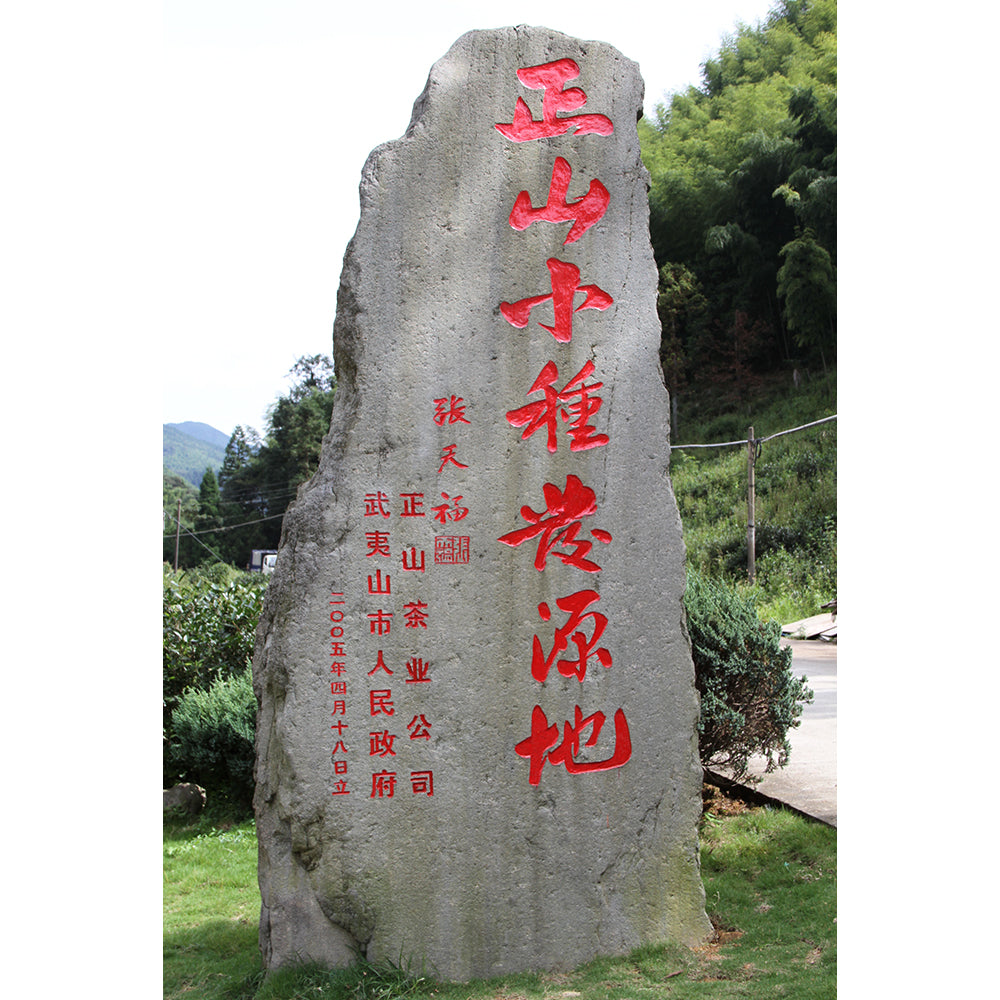
The birthplace of Lapsang Souchong black tea is Jiangdun and Miaowan Natural Village, 5 kilometers northeast of Tongmu Village, Xingcun Town, Wuyishan City (formerly Chong'an County). Mr. Zhang Tianfu, a leading figure in the contemporary tea industry, once wrote an inscription for Miaowan, "The Origin of Lapsang Souchong." Jiang Dun is named after the family name Jiang. The Jiang family has been engaged in tea business for generations and is known as the "tea family".
桐木关.jpg__PID:a4024b39-9122-469a-a9e8-51ec5ad5bd39

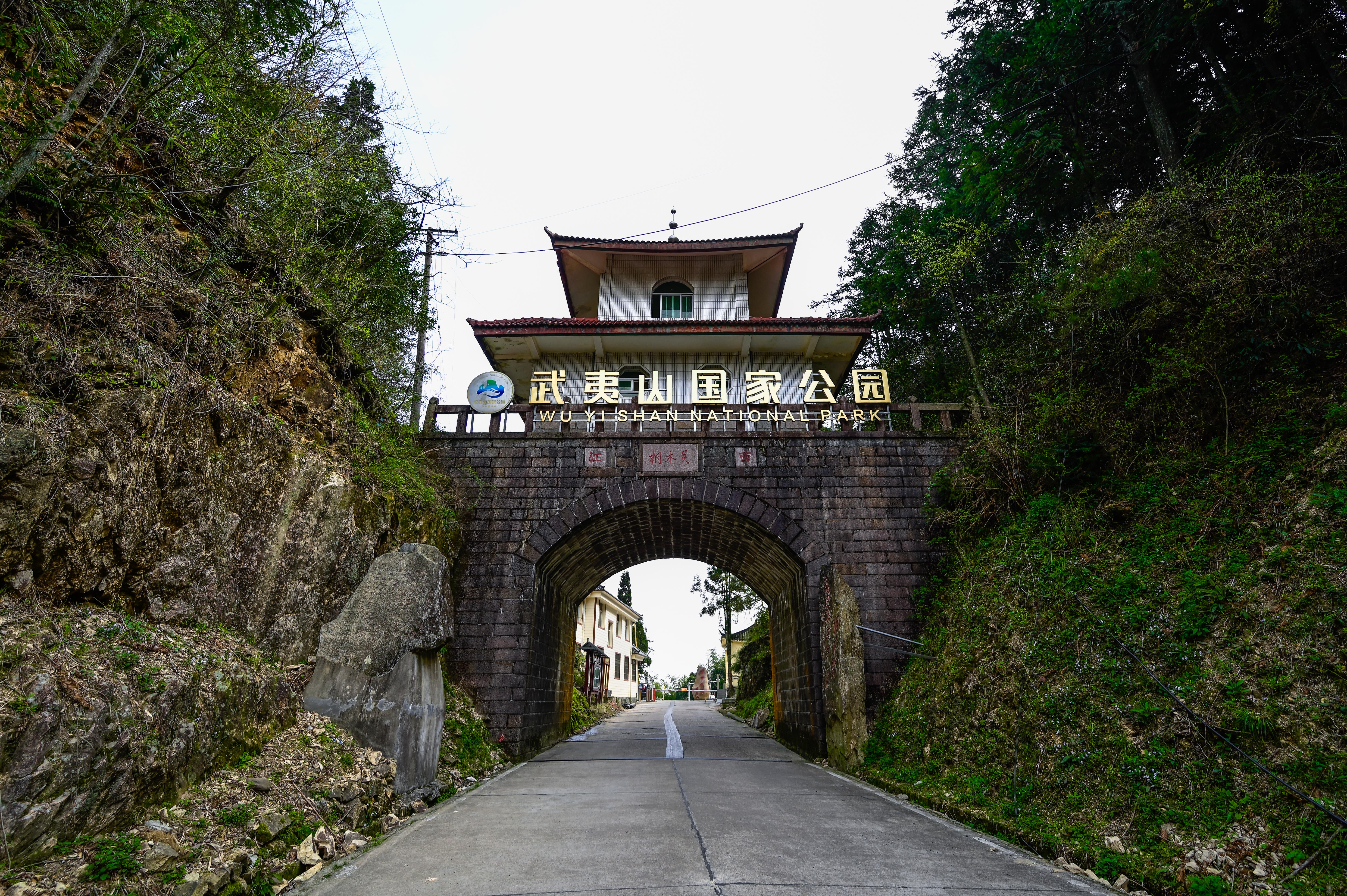
Tongmu Village, Xingcun Town, Wuyishan City (formerly Chong'an County)
3.jpg__PID:10d8a78f-941d-4075-a5bc-8aa0edeecad3

The Origin of Lapsang Souchong

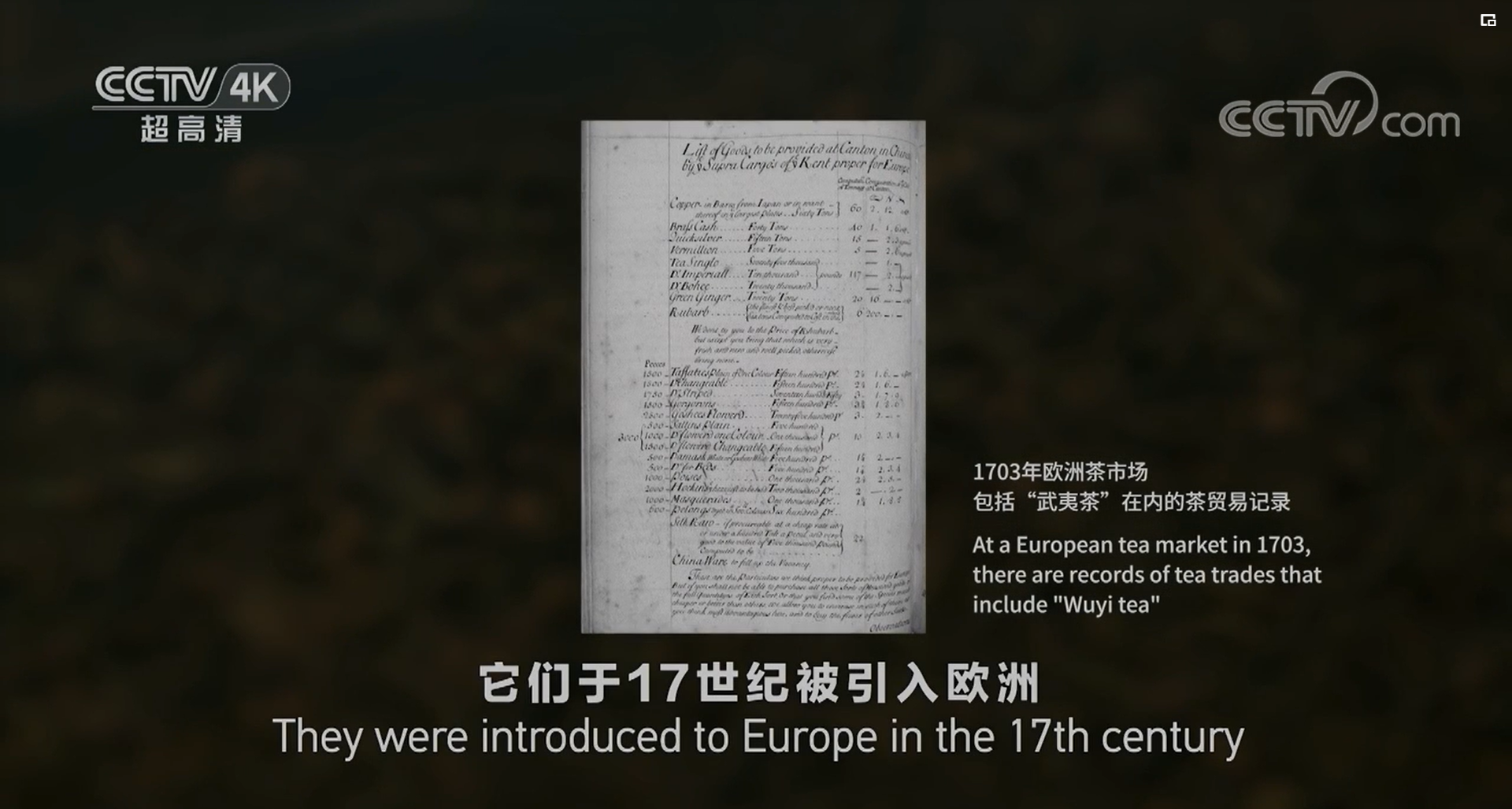
In 1604, Dutch merchants brought Lapsang Souchong to Europe — marking the firstever introduction of black tea to the West. It would later spread among European royal courts and win great favour among nobility.

GIn 1662, Princess Catherine of Braganza introduced this tea to the British royal court as part of her dowry. Its delicate pine aroma captivated the European nobility, helped pave the way for classic British afternoon tea culture, and firmly established its reputation as a “Royal favourite.”
4.jpg__PID:694d33de-0d01-4698-a407-25352a66d916
5.jpg__PID:1245f44c-6136-4a09-b7ee-498367c7d8a4

AAlthough black tea originates in China, it has gained great popularity abroad, especially in the United Kingdom. Since black tea was first introduced to Britain in the 17th century, an elegant black tea culture has gradually evolved and become the mainstream in the world of tea.

下午茶文化 2.jpg__PID:134a53c2-7fbd-4ffa-86a1-99797ff7265b

Ecological Origin and Traditional Craft

-Ecological Origin

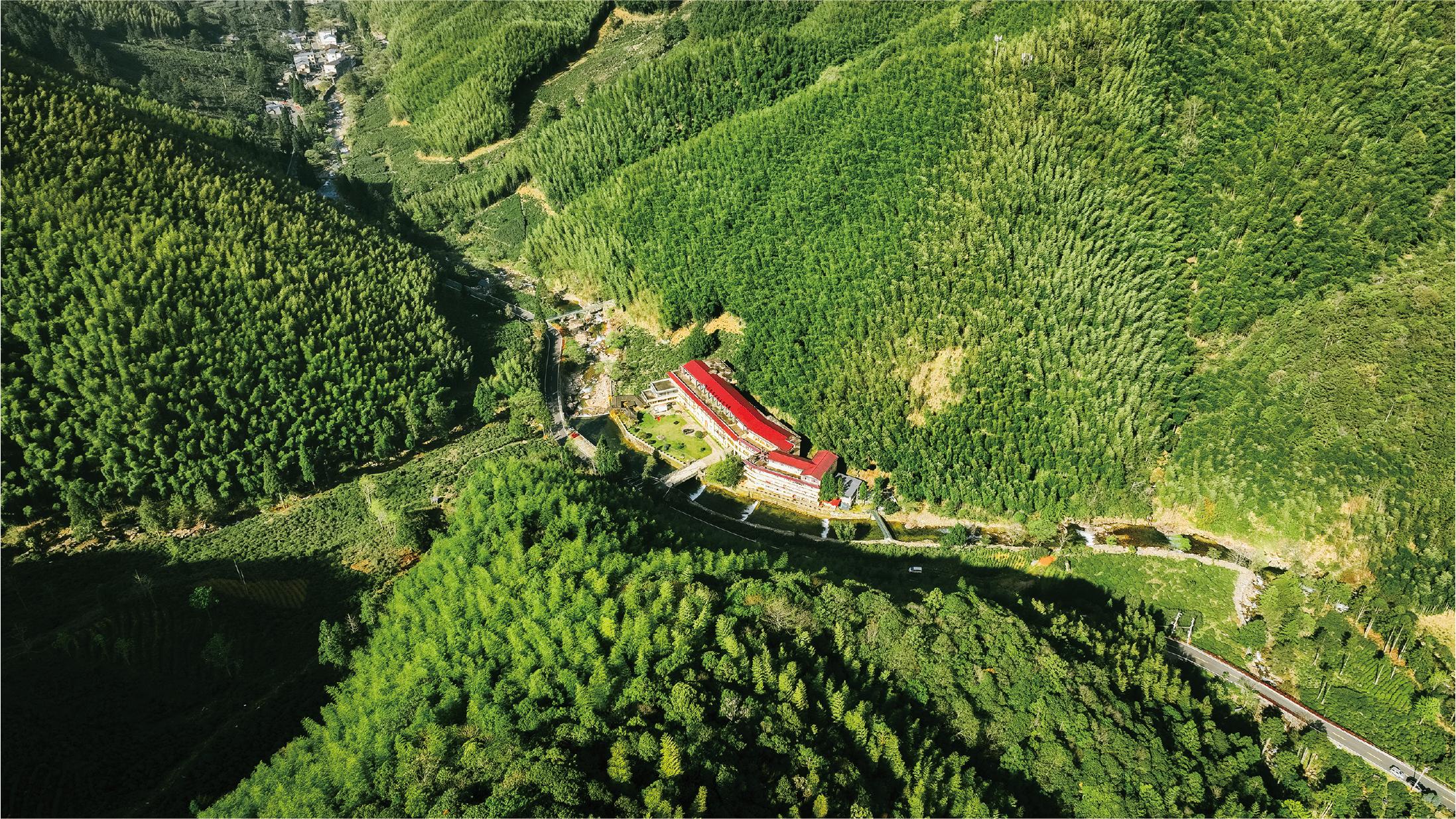
The tea leaves are sourced from pristine high-altitude tea mountains at elevations above 800 meters in the Wuyi Mountains National Nature Reserve, where strict forest protection and logging bans preserve the natural tea-growing ecosystem and prevent overdevelopment.

茶山及茶园7.jpg__PID:13350484-c123-42e4-83d2-5b4480d29e89

A Habitat of Diverse Creatures

Wuyi Mountain National Park is an important distribution area for rare and endangered species in China, including Cabot's Tragopan and the Golden Kaiser-i-Hind. It is highly regarded by both Chinese and foreign biologists as "the paradise of birds," "the kingdom of snakes," "the world of insects," and "the key to studying Asian amphibians and reptiles."

Ideal fertile Terroir for tea cultivation

Wuyi Mountain Nature Reserve is a crucial area for global biodiversity conservation. With an average altitude of 1, 200-1, 500 meters, the area features a large temperature difference between day and night, which contributes to abundant accumulation of organic matter. Cold, snowy winters suppress teaplant pest populations. The soil is well-developed, fertile, loose in texture, well-drained and rich, in organic matter.

自然人文风景 (2).jpg__PID:00055559-9e69-4ca7-bf16-c6577f2cab7f
自然人文风景 (13).jpg__PID:9b161335-0484-4123-82e4-43d25b4480d2
自然人文风景 (16).jpg__PID:ebc2bd88-f19f-4e04-977a-dcc9d184f2df
the production of lapsang souchong.jpg__PID:500cc18a-9830-4acf-8556-c2f87e56a815

1,500 meters/Altitude: The average altitude of tea mountains is 800-1500 meters. Due to the high altitude, the temperature difference between day and night is large, which is very conducive to the growth of tea trees.

18°C/Temperature:
It belongs to the subtropical monsoon humid climate, with an annual average temperature of about 18°C. There are many nitrogen-containing compounds such as amino acids and proteins produced and accumulated in the tea tree.

2000 mm/Precipitation:
The annual precipitation is above 2000 mm. The tea has good tenderness, high quality, and can avoid freezing damage.

85% / Relative Humidity: The annual relative humidity is as high as 85%. The area enjoys over 100 foggy days each year, with the high mountains shrouded in clouds and mist.

pH 4.5–5 / Soil: The soil belongs to the mountain yellow soil and yellow-red soil types, with a pH value of 4.5 to 5 and a soil depth of 30–90 cm. The soil is loose and naturally fertile, eliminating the need for chemical fertilizers.

96.3% / Forest Coverage Rate: With a forest coverage rate of 96.3% and a well-preserved ecosystem, the area has formed a complete and balanced biological chain, creating a "natural protective barrier" for tea-trees growth.
红茶说明手册提取图片 (3).jpg__PID:98e59f74-28f1-4979-92a8-424530dc0838

-Traditional Craft

Crafted by Jiang Yuanxun, the 24th-generation inheritor of Lapsang Souchong's traditional tea-making craft, and following time-honored orthodox techniques, this tea upholds the centuries-old quality standards of "Royal Black Tea." Adopting traditional pine-smoke curing and the classic cutting process, it faithfully recreates the authentic taste of historic export-style black tea. It delivers a subtle, elegant pine aroma alongside mellow and sweet tea liquor, presenting the timeless charm of genuine Wuyi orthodox black tea.

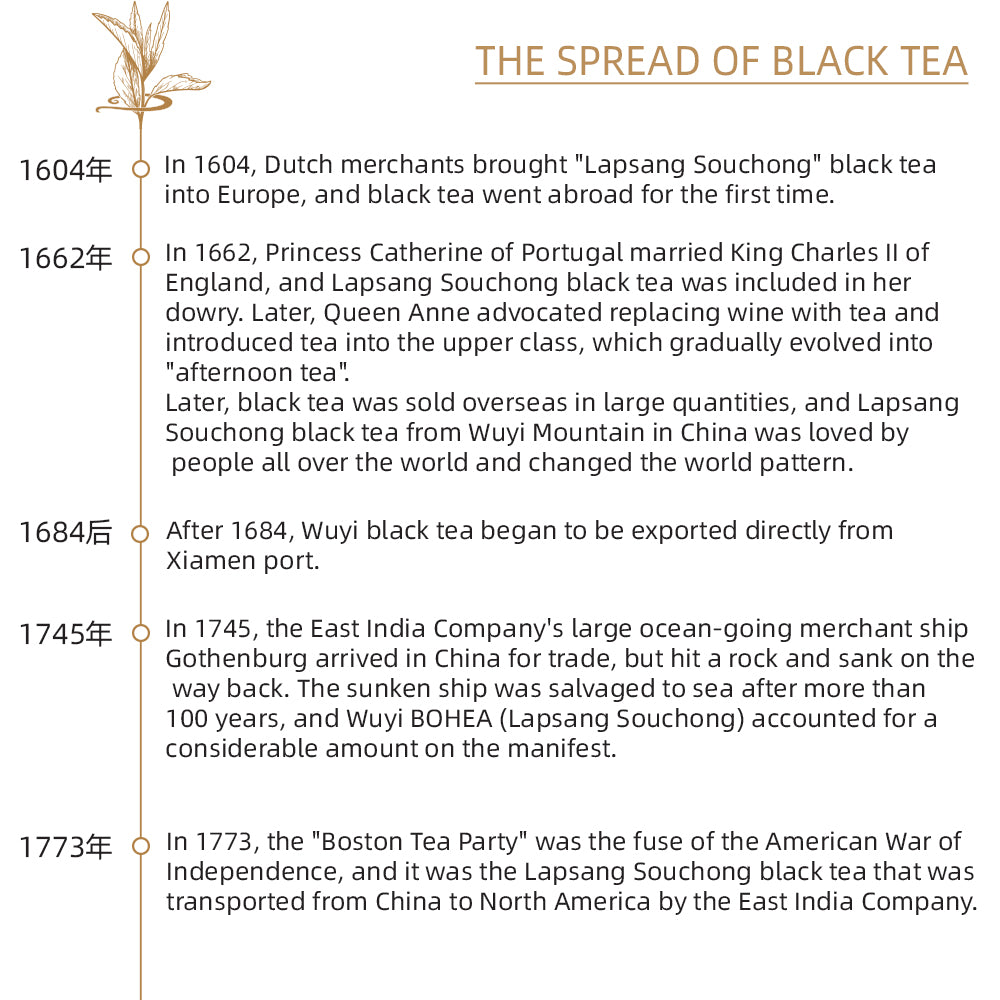
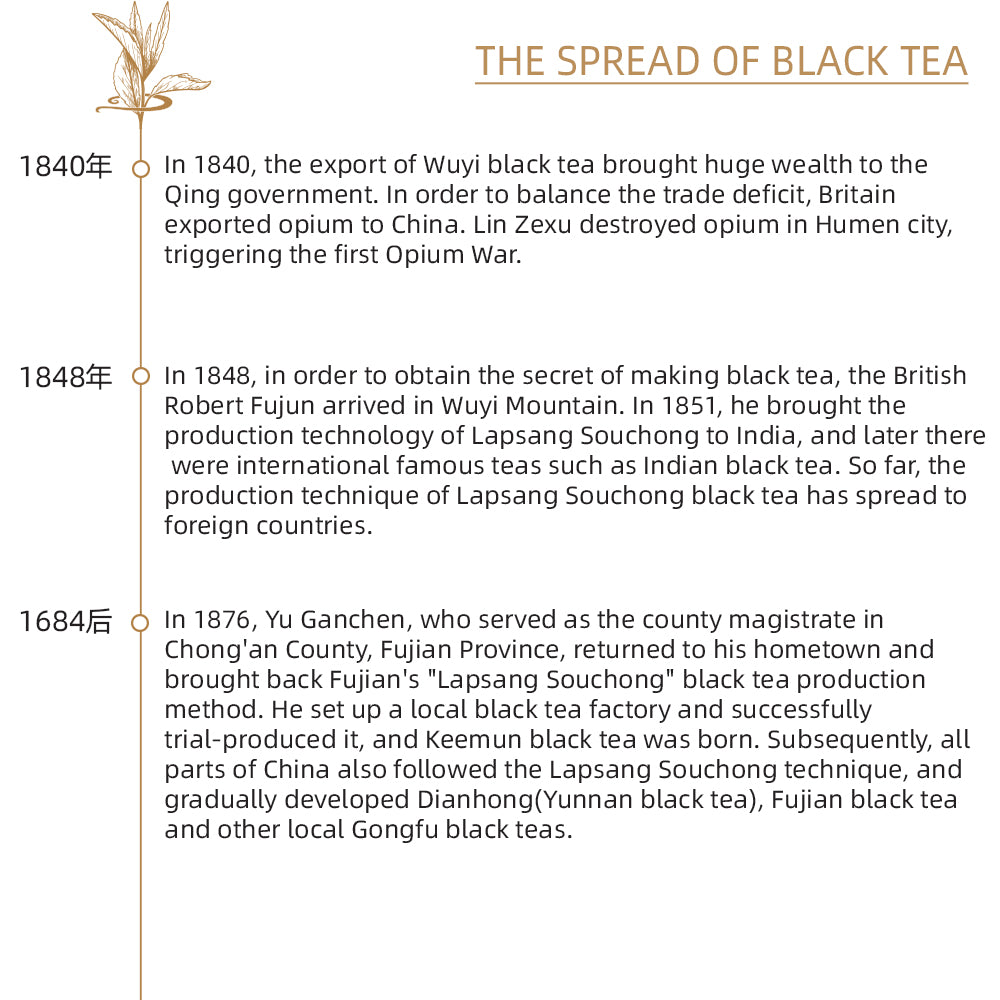
1604

In 1604, Dutch merchants brought "Lapsang Souchong" black tea into Europe, and black tea went abroad for the first time.

1662

In 1662, Princess Catherine of Portugal married King Charles II of England, and Lapsang Souchong black tea was included in her dowry. Later, Queen Anne advocated replacing wine with tea and introduced tea into the upper class, which gradually evolved into "afternoon tea".Later, black tea was sold overseas in large quantities, and Lapsang Souchong black tea from Wuyi Mountain in China was loved by people all over the world and changed the world pattern.

1684

After 1684, Wuyi black tea began to be exported directly from Xiamen port.

1745

In 1745, the East India Company's large ocean-going merchant ship Gothenburg arrived in China for trade, but hit a rock and sank on the way back. The sunken ship was salvaged to sea after more than 100 years, and Wuyi BOHEA (Lapsang Souchong) accounted for a considerable amount on the manifest.

1745

In 1745, the East India Company's large ocean-going merchant ship Gothenburg arrived in China for trade, but hit a rock and sank on the way back. The sunken ship was salvaged to sea after more than 100 years, and Wuyi BOHEA (Lapsang Souchong) accounted for a considerable amount on the manifest.

1773

In 1773, the "Boston Tea Party" was the fuse of the American War of Independence, and it was the Lapsang Souchong black tea that was transported from China to North America by the East India Company.

1840

In 1840, the export of Wuyi black tea brought huge wealth to the Qing government. In order to balance the trade deficit, Britain exported opium to China. Lin Zexu destroyed opium in Humen city, triggering the first Opium War.

1876

In 1876, Yu Ganchen, who served as the county magistrate in Chong'an County, Fujian Province, returned to his hometown and brought back Fujian's "Lapsang Souchong" black tea production method. He set up a local black tea factory and successfully trial-produced it, and Keemun black tea was born. Subsequently, all parts of China also followed the Lapsang Souchong technique, and gradually developed Dianhong(Yunnan black tea), Fujian black tea and other local Gongfu black teas.

Traditional Pine-Smoke Craft

Traditional Cut-Strip Craft

IMG_0249.JPG__PID:1278972d-c35f-4432-86e0-e8d39a7c2b49
熏焙工艺.jpg__PID:50b81278-972d-435f-b432-46e0e8d39a7c
马尾松木熏制.jpg__PID:972dc35f-f432-46e0-a8d3-9a7c2b49d206
主图4.jpg__PID:3dcc9d15-3f89-4a82-b4ca-7a2e531759ed
主图3.jpg__PID:01163dcc-9d15-4f89-aa82-b4ca7a2e5317
三级干茶.jpg__PID:b950b812-7897-4dc3-9ff4-3246e0e8d39a

Following the ancient pine-smoke roasting techniques of Lapsang Souchong with a moderate smoke intensity, this tea features a mild and mellow pine aroma that is smooth and unaggressive. The fragrance is fully integrated into the tea liquor, perfectly balancing the classic smoky character with sweet richness—forming the signature flavor of authentic royal black tea.

Performed after the initial tea-making process, cutting is an essential step in the refining process of traditional Lapsang Souchong black tea, significantly enhancing the extraction rate and efficiency of its soluble components during brewing.

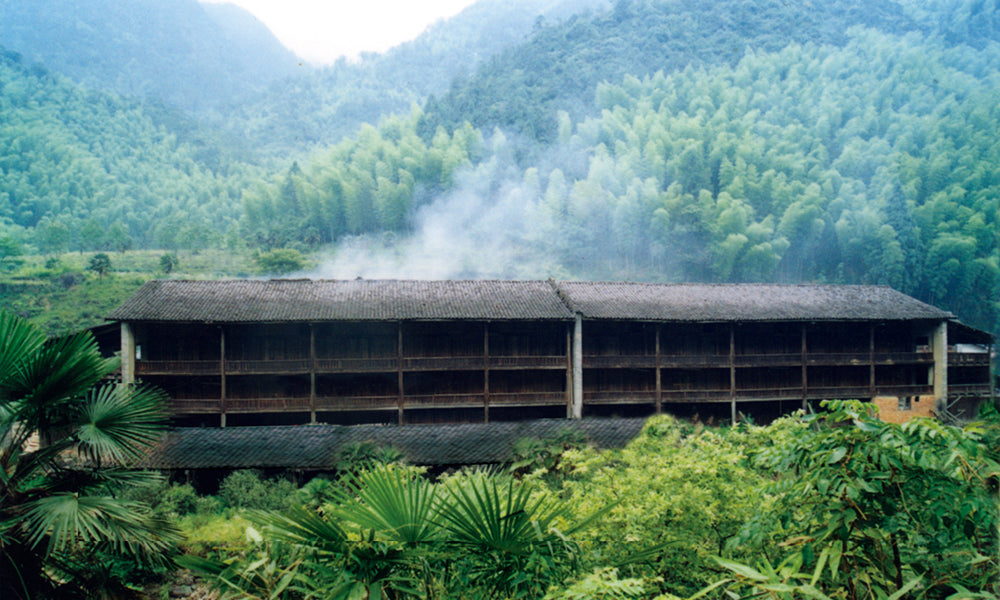
-Qinglou, a centuries-old tea-processing wooden building

Qinglou is an ancient wooden building used for processing tea laves. It is divided into three and a half levels.
Ground Floor: The bottom half-level is used to burn Masson pine, generating heat and pine smoke that rise through the building.
First floor: Serves as smoking-roasting room. The fermented tea leaves are placed on round bamboo sieves, which are then set onto baking racks for smoking and roasting.
Second floor: The temperature of the Qinglou can be adjusted by opening and closing the door.
Third floor: The residual temperature is used to wither fresh leaves. During the tea-making season, the Qinglou is always filled with the  aroma of pine smoke.
正山小种红茶.jpg__PID:10b86843-9d01-4412-b89a-8b4b8c862127

-How does Lapsang Souchong's pine-smoke aroma form?

Masson pine wood is an essential raw material for traditional Lapsang Souchong tea processing. Carefully smoked in the tea-processing Qinglou of Tongmuguan in Wuyi Mountain, the tea leaves absorb rosin continuously during the process of withering and drying, which gives Lapsang Souchong its distinctive pine-smoke and dried-longan aroma.

The Quality of Medium-Smoked Royal Black Tea

Dry leaf

Tight and heavy strips, with black bloom color.


主图4.jpg__PID:42f9c932-dced-412d-95d8-fbd7978f1407

Liquor

Bright orange-yellow.


主图5.jpg__PID:c932dced-c12d-45d8-bbd7-978f14074542

Flavor

Strong and lasting pine-smoky notes with dried-longan fragrance.


主图4.jpg__PID:b8020775-5825-42ee-94f7-9b334de29723

Leaf after brew

Mellow, thick and brisk, with dried-longan flavor.


主图6.jpg__PID:32dcedc1-2d15-48fb-9797-8f1407454278

Storage resistance

Under normal temperature conditions, the quality can remain unchanged for three to five years or even longer, the taste will be more mellow, and the pine fragrance will be more pure and refreshing.
1采摘.jpg__PID:b9c6903a-8c5e-488e-9f99-c600203c2434

Range of Pine‑Smokey Notes and Buying Guide

Tasting notes

Dry leaf: Bold and heavy strips, with jet black color.                Liquor: Bright orange-yellow.
Aroma: Strong and lasting pine-smoky notes with dried-longan fragrance.             
Taste: Mellow, thick and brisk, with dried-longan flavor.
Wet leaf: Fully opened leaves with bronze color.

Shop Now
「正山堂」本色紅茶50g缶(有煙型正山小種)[ZSY11]
Bense Smoked Lapsang Souchong Black Tea - Lapsangstore
「正山堂」本色紅茶50g缶(有煙型正山小種)[ZSY11]
Bense Smoked Lapsang Souchong Black Tea - Lapsangstore
「正山堂」本色紅茶50g缶(有煙型正山小種)[ZSY11]
红茶叶茶冲泡指南
「正山堂」本色紅茶50g缶(有煙型正山小種)[ZSY11]
Bense Smoked Lapsang Souchong Black Tea - Lapsangstore
「正山堂」本色紅茶50g缶(有煙型正山小種)[ZSY11]
Bense Smoked Lapsang Souchong Black Tea - Lapsangstore
「正山堂」本色紅茶50g缶(有煙型正山小種)[ZSY11]
Bense Smoked Lapsang Souchong Black Tea - Lapsangstore
「正山堂」本色紅茶50g缶(有煙型正山小種)[ZSY11]
红茶叶茶冲泡指南
「正山堂」本色紅茶50g缶(有煙型正山小種)[ZSY11]
Bense Smoked Lapsang Souchong Black Tea - Lapsangstore

「正山堂」本色紅茶50g缶(有煙型正山小種)[ZSY11]

$42.00
$42.00
「正山堂」本色紅茶テイスティングパック・5gパック(有煙型正山小種)[ZSY11]
3 Bense Smoked Lapsang Souchong Mini Bags - Lapsangstore
「正山堂」本色紅茶テイスティングパック・5gパック(有煙型正山小種)[ZSY11]
3 Bense Smoked Lapsang Souchong Mini Bags - Lapsangstore
红茶叶茶冲泡指南
「正山堂」本色紅茶テイスティングパック・5gパック(有煙型正山小種)[ZSY11]
3 Bense Smoked Lapsang Souchong Mini Bags - Lapsangstore
「正山堂」本色紅茶テイスティングパック・5gパック(有煙型正山小種)[ZSY11]
3 Bense Smoked Lapsang Souchong Mini Bags - Lapsangstore
「正山堂」本色紅茶テイスティングパック・5gパック(有煙型正山小種)[ZSY11]
3 Bense Smoked Lapsang Souchong Mini Bags - Lapsangstore
「正山堂」本色紅茶テイスティングパック・5gパック(有煙型正山小種)[ZSY11]
3 Bense Smoked Lapsang Souchong Mini Bags - Lapsangstore
红茶叶茶冲泡指南
「正山堂」本色紅茶テイスティングパック・5gパック(有煙型正山小種)[ZSY11]
3 Bense Smoked Lapsang Souchong Mini Bags - Lapsangstore
「正山堂」本色紅茶テイスティングパック・5gパック(有煙型正山小種)[ZSY11]
3 Bense Smoked Lapsang Souchong Mini Bags - Lapsangstore

「正山堂」本色紅茶テイスティングパック・5gパック(有煙型正山小種)[ZSY11]

$15.43
$12.48
Bense Smoked Lapsang Souchong Black Tea Luxury Gift Box
Bense Smoked Lapsang Souchong Black Tea Luxury Gift Box - Lapsangstore
Bense Smoked Lapsang Souchong Black Tea Luxury Gift Box
Bense Smoked Lapsang Souchong Black Tea Luxury Gift Box - Lapsangstore
Bense Smoked Lapsang Souchong Black Tea Luxury Gift Box
Bense Smoked Lapsang Souchong Black Tea Luxury Gift Box - Lapsangstore
Bense Smoked Lapsang Souchong Black Tea Luxury Gift Box
红茶叶茶冲泡指南
Bense Smoked Lapsang Souchong Black Tea Luxury Gift Box
Bense Smoked Lapsang Souchong Black Tea Luxury Gift Box - Lapsangstore
Bense Smoked Lapsang Souchong Black Tea Luxury Gift Box
Bense Smoked Lapsang Souchong Black Tea Luxury Gift Box - Lapsangstore
Bense Smoked Lapsang Souchong Black Tea Luxury Gift Box
Bense Smoked Lapsang Souchong Black Tea Luxury Gift Box - Lapsangstore
Bense Smoked Lapsang Souchong Black Tea Luxury Gift Box
红茶叶茶冲泡指南
Bense Smoked Lapsang Souchong Black Tea Luxury Gift Box

Bense Smoked Lapsang Souchong Black Tea Luxury Gift Box

$242.34
$242.34

Brewing Guide

Gaiwan (covered bowl) is recommended for brewing.
1、Warm your vessel, add 5 g tea leaves and inhale the dry-leaf aroma.
2、Pour in pure water at around 90 °C-95 ℃ for infusion.
3、For the 1-4 infusions: pour out liquor quickly, no prolonged steeping.
      For 5-7 infusions: steep for 5-10 s.
      For 7-10 infusions: steep for about 15 s.Extend steeping time gradually with each subsequent brew to keep consistent liquor quality.

盖碗.jpg__PID:43f53b04-ce0a-4379-b758-c2879655d025

Gaiwan

水温.jpg__PID:f53b04ce-0ae3-49b7-98c2-879655d025b6

90 ℃-95 ℃

出汤时间.jpg__PID:0243f53b-04ce-4ae3-b9b7-58c2879655d0

Infusion time

Frequently asked questions

This tea is black tea, unlike post-fermented teas. It can be well-preserved under cool, dry, dark and odor-free conditions, yet it is not meant for multi-year, long-term aging. Best consumed within 2-3 years after production to enjoy its full pine-smoke, dried-longan and fresh flavor profile.

Videos about This Tea