 Passer au contenu


The Craftsmanship and Cultural Connotations of
the "Yili Zhu" (Single Pearl) Zisha Teapot
By Zhang Zhiqing
Yixing Zisha teapots originated from traditional folk handicrafts. Their unique material and diverse forms have long been cherished by enthusiasts. As history has progressed and people's living standards have improved, they have evolved from coarse pottery utilitarian wares into artworks that combine practicality with aesthetic value. Considered the finest choice among tea vessels, they are honored as the "King of Tea Wares." This signifies that Zisha teapots are intrinsically linked to tea culture, sharing the same lineage. Rooted in profound tea culture and rich in humanistic connotations, they stand unique in the field of global ceramic art and are treasured gems of traditional Chinese culture.

1. The Form of the "Yili Zhu" Zisha Teapot
People have diverse personalities, and teapots have myriad forms. Appearance is the foundation of a teapot; only with a proper and dignified appearance can a teapot express its spirit and possess unique artistic charm. Throughout the long history of development, Zisha teapot artistry—from form to decoration—has been continuously innovated by artisans across generations, forming a comprehensive artistic system that can be described as a school of its own. A truly excellent teapot represents the synergy of clay material, form, and decoration. They interact with and complement each other, enhancing the work's aesthetic value while fulfilling practical needs.

"Yili Zhu" is a traditional smooth-surfaced teapot form, centered on the circle. Through soft and fluid lines, it shapes a round, full-bodied form, evoking the feeling of pearls—round, smooth, and lustrous. Observing this teapot: the body is perfectly round with excellent tension; the belly is full; the lines are soft yet powerful; the center of gravity is stable, presenting a dignified and magnanimous appearance. The base is a flat foot, stable, dignified, and grand. The spout is a three-curve style, thick, full, and bends freely. The three-curve spout is among the more elegant spout forms, shaped like a bird's beak, with a clean, powerful outlet. The round handle complements the curved spout, with moderate curvature and well-proportioned thickness variations, appearing gentle, dignified, elegant, and grand. The lid is an inset style, fitting seamlessly with the body, creating visual harmony. The lid knob is a small round pearl, positioned at the center of the entire teapot, full and translucent like a pearl. The large pearl of the body and the small pearl of the knob are endearing, inseparable like "mother and child pearls," which is delightful. The entire teapot is composed of curves yet does not appear weak. While the form is full, calm, broad, and elegant, the upright and graceful spout and handle offset the heaviness of the body, making the whole teapot dignified yet concise, creating an aesthetic realm of simple yet powerful beauty.


2. The Decoration of the "Yili Zhu" Zisha Teapot
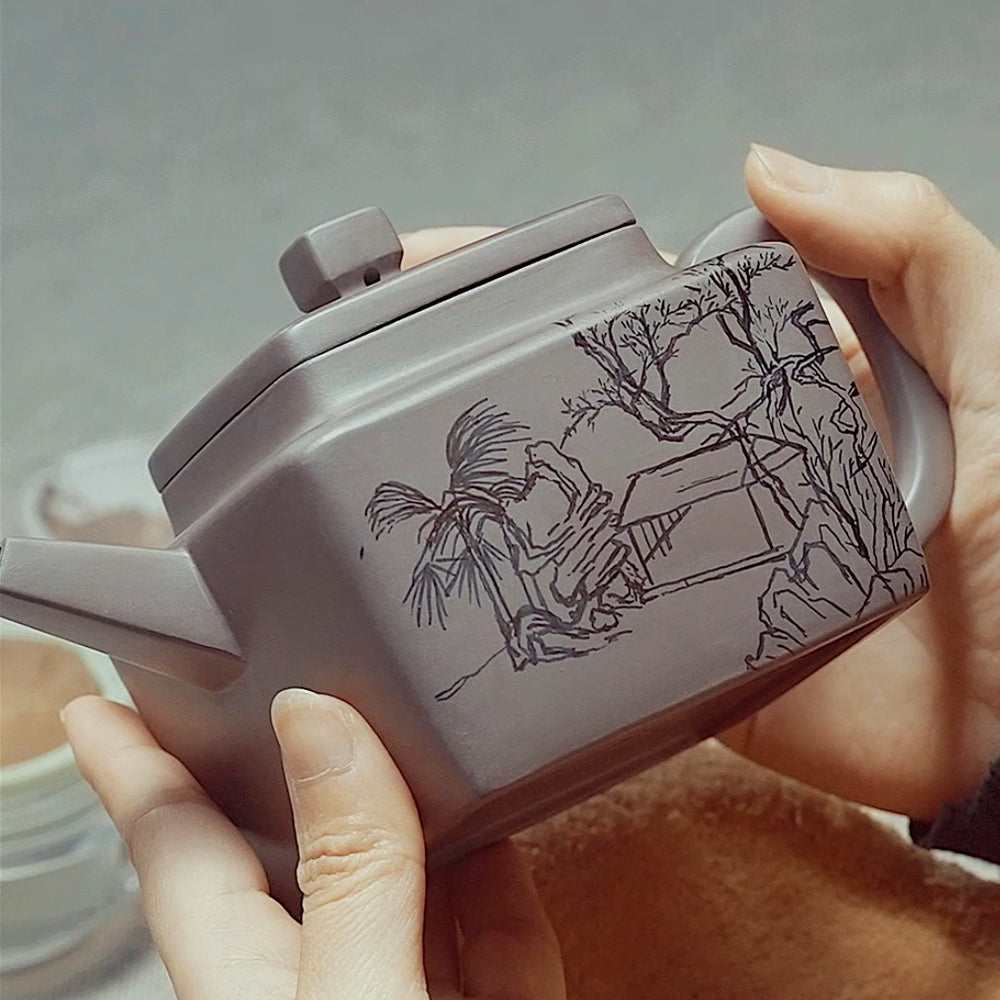
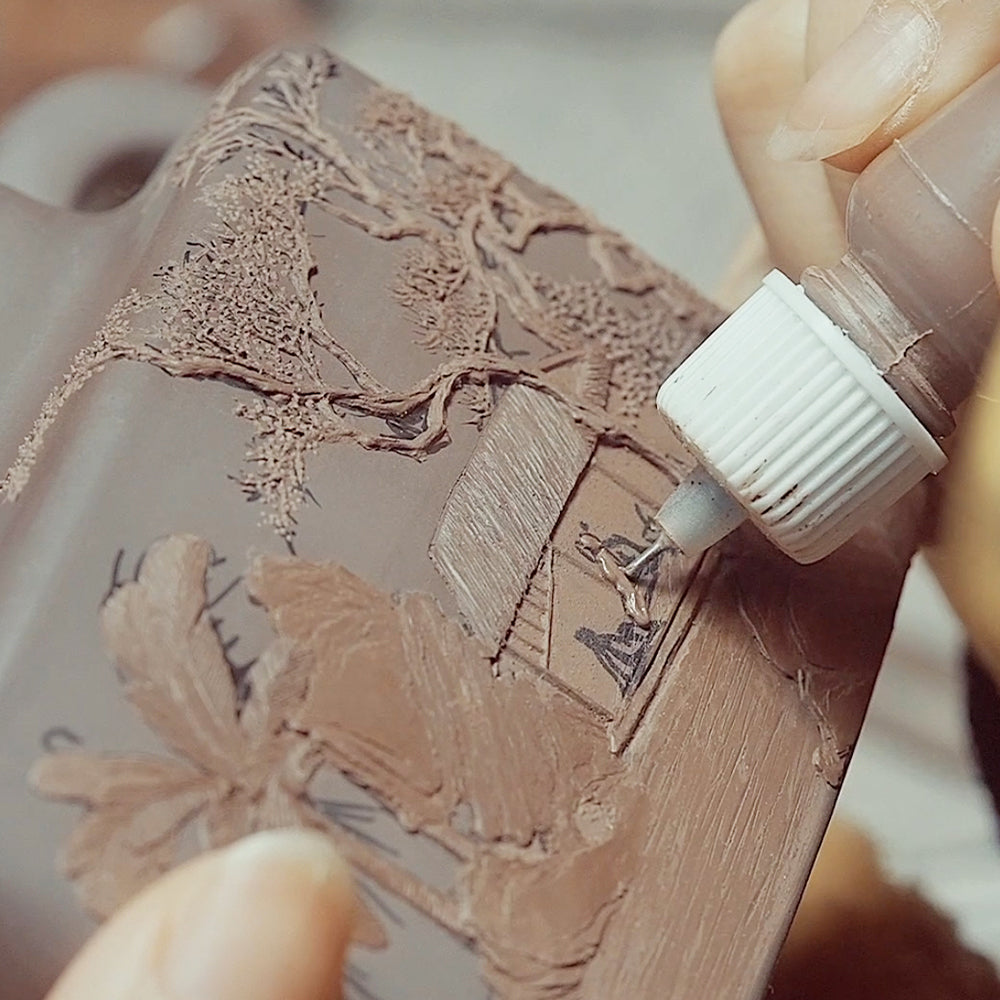
Clay painting is one of the traditional decorative techniques for Zisha teapots, involving decorating the teapot body according to a pre-designed layout. The themes for clay painting decoration are diverse, with figures, landscapes, flowers, and birds being common subjects. Clay painting requires a certain foundation in drawing and is more challenging than traditional calligraphy and painting. Traditional painting is done on flat paper, while clay painting is done on the curved surface of the teapot body, which naturally makes a difference. This decorative technique aligns with the aesthetic pursuit of magnificence and romance in imperial court Zisha.
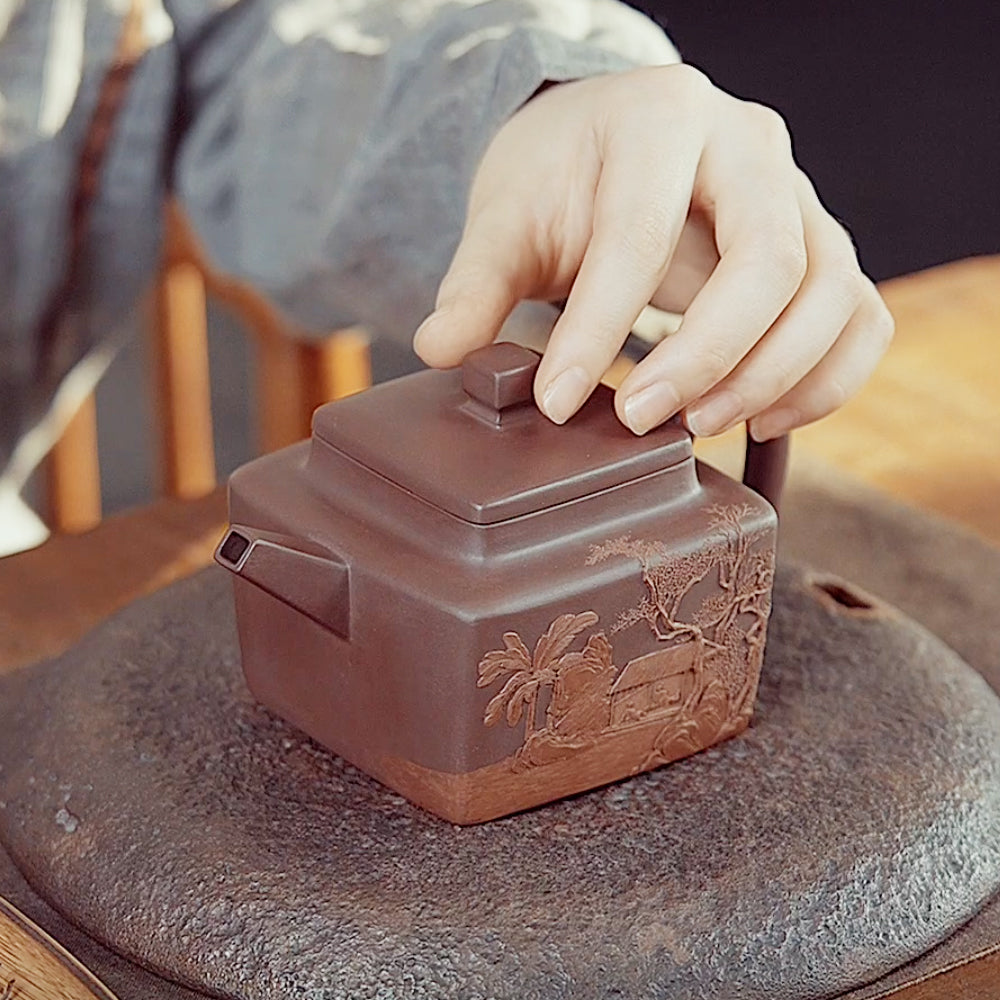
The main theme of the colored painting on this teapot is "Listening to the Spring, Waiting for Guests." Dense mountain forests, layered peaks, a clear stream cascading down from the mountains—at the foot of the continuous mountains lie several households far from the hustle and bustle, living in harmony and contentment. Surrounding trees are lush and green. A Confucian scholar listens to the spring sound while brewing tea by a stove. A wooden bridge connects to another range of mountains. During the day, residents gather firewood and hunt in the mountains, living a leisurely and content life.
On the other side of the teapot is inscribed a poem by the Tang Dynasty poet Wang Wei:
"I know not the path to the Temple of Fragrant Incense,
For miles I walk amidst clouds on peaks.
Ancient trees, no footpath for men;
Deep in the mountains,
whence comes the bell's toll?
Spring's murmur chokes over steep rocks;
Sunlight seems chilled by the green pines.
At dusk, by the empty, winding pool,
In deep meditation, I subdue the dragon of desire."
This poem depicts the deep and secluded artistic conception of an ancient mountain temple, moving from distance to proximity, from scene to emotion, creating a realm of lofty seclusion. It expresses the poet's mindset of withdrawing from the bustling world and yearning for an idyllic life.
The clay painting on this teapot emphasizes the harmony between the soul and nature. Appreciating it, beautiful and vast natural scenery bursts into view with abundant vitality. Every cloud, every tree, every mountain, and every river in the work seems to exude life and spirituality. The viewer's soul is purified, their realm elevated, allowing them to feel the vastness of heaven and earth and the grandeur of spirit. It can be said that the skill of clay painting decoration adds brilliance to this teapot, giving the work a dignified and graceful temperament while enriching its overall artistic conception and humanistic depth.
3. The Artistic Realm of the "Yili Zhu" Zisha Teapot
"Yili Zhu" embodies a sense of dignified simplicity. The entire teapot emanates a tranquil aura, reflecting the Buddhist and Zen philosophy of stillness. In these traditions, stillness and a "mind like calm water" are highly valued. The teapot's composed and elegant form naturally brings to mind Buddhist prayer beads, which practitioners use as a tool for meditation and focus. Those who use prayer beads are less concerned with their physical attributes—how they are made, how many beads they have, or what material they are made from—and instead focus on cultivating a quiet mind, letting go of distracting thoughts, and maintaining a centered awareness.
Buddhism and Zen encourage inner peace and equanimity. They teach returning to a state of calm—avoiding arrogance, refraining from showing off, not being swept away by extreme emotions, remaining unmoved by external circumstances, and not letting worries show on one's face. Does not the "Yili Zhu" teapot resonate deeply with this philosophy? It represents the gathering of countless thoughts into a single point of focus. It embodies calmness, sedimentation, the supreme good that is like water, and a mind as clear as a mirror.
Furthermore, the "Yili Zhu" is full and round, resembling a glistening, translucent drop of water. The beauty of a water droplet—captured in the line "Heavy is the dewdrop on the lotus leaf, light are the rainbow-colored clouds gathered by the sky"—is captivating. Yet, beyond this enchanting and delicate beauty, the water droplet also symbolizes perseverance and persistence, as expressed in the idiom "dripping water wears through stone." How hard is stone? Yet it is gradually penetrated by soft, tiny drops over time. This spirit of sustained, unyielding effort has been revered throughout Chinese history and represents a profound spiritual strength.


The "Yili Zhu" Zisha teapot truly demonstrates excellence in form, function, and utility. Its external shape both honors traditional methods and incorporates innovative elements, presenting an aesthetic that condenses time and space. The clay painting decoration is magnificent yet imbued with a quiet Zen quality, elevating the work's humanistic depth and cultural significance.




Our Best Seller
Family Chair Set
Sustainable - Eco-friendly materials - For sensitive skin
The above is the clay painting process of Zhang Ye's work "Hidden Mountain"
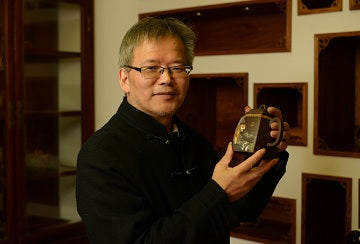
Zheng Zhiqing 张志清
Senior arts and crafts artist.
Master of Chinese traditional crafts.
Known as the first person of Chinese purple sand clay painting
The reform and opening up has given great impetus and development opportunities to zisha crafts, and several schools of Yixing Zisha Artists Have Emerged, Zhang Zhiqing is one of the best.Through decades of study and exploration, Mr. Zhang Zhiqing has rejuvenated the color mud pile painting technique that has been silent for more than two hundred years. Zhang Zhiqing was born in Yixing, Jiangsu. His ancestral business was a "Small Kiln Household" that produced daily-use pottery. He relied on his own production and management to make a living. He suffered a lot when he was young. Working as a glaze worker in a painted pottery factory gave him a deep understanding of materials, and helping others restore Yang Jichu's Works allowed him to see the direction to pursue in craftsmanship. His training gave him the potential to create.Zhang Zhiqing was engaged in clay painting without any Inheritance. He Liked Calligraphy And Painting In His Early Years And Had A Certain Foundation In Art. However, Purple Sand clay painting is not simply transplanting calligraphy or paintings onto pots, but requires a combination of brushes, mud, purple sand pottery blanks, and kiln fire. Of mutual combination. Mr. Zhang Zhiqing created the "Colored Mud Painting" of purple sand, so that the mud can become colorful in the firing of the kiln fire. Secondly, he created "Fine Clay Painting". In his works, the faces Of People Smaller Than Mung Beans Have Distinct Features And Rich Expressions. The Hair Of Animals Is Not Messy, And The landscape is full of vitality. Breathtaking,his works are literati works, which are extremely beautiful and influential in expressive force, with profound skills and profound artistic conception. What is gratifying is that Zhang Zhiqing has not only brought back the brilliance of the skill of colored clay painting, but also spread and carried forward what he has learned and thought. So far, he has taught more than 50 apprentices.His Daughter, Zhang Ye, also inherited the mantle of her father's generation and became an artist of today's purple sand clay painting.

Zhangye 张烨
National arts and crafts artist
Zhang Ye grew up in a family of Zisha pottery artists since he was a child. Influenced by his father Zhang Zhiqing, he fell in love with this craft from the bottom of his heart. After graduating from university, he followed his father to learn purple sand clay painting skills, and then entered Nanjing Normal University for further studies in fine arts, and achieved good results.From Zhang Ye's works, we can see not only the inheritance of skills from generation to generation, but also the difference in his artistic style from his father's. She excavates the elegant and gentle beauty in traditional culture from a female perspective, and her works are delicate, elegant and delicate. Moreover, as a new generation, she is also making various exploration attempts, making this skill full of more possibilities and imagination. Chinese, classical, romantic, even cartoon, and all themes from the world can be used to boldly create works with warmth and emotion.
In September of this year, we finally reached a cooperative relationship with these two famous purple sand artists in Yixing, and we can make the pot you want at a very reasonable price.

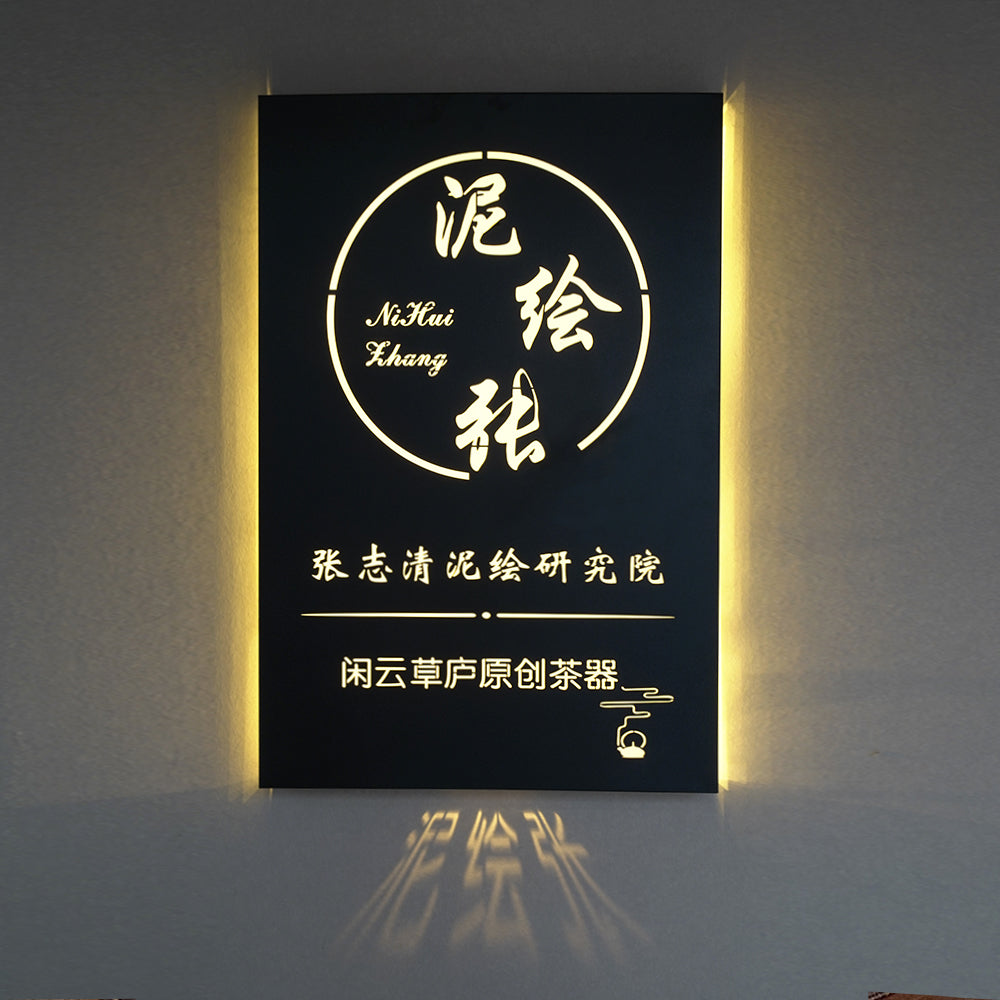
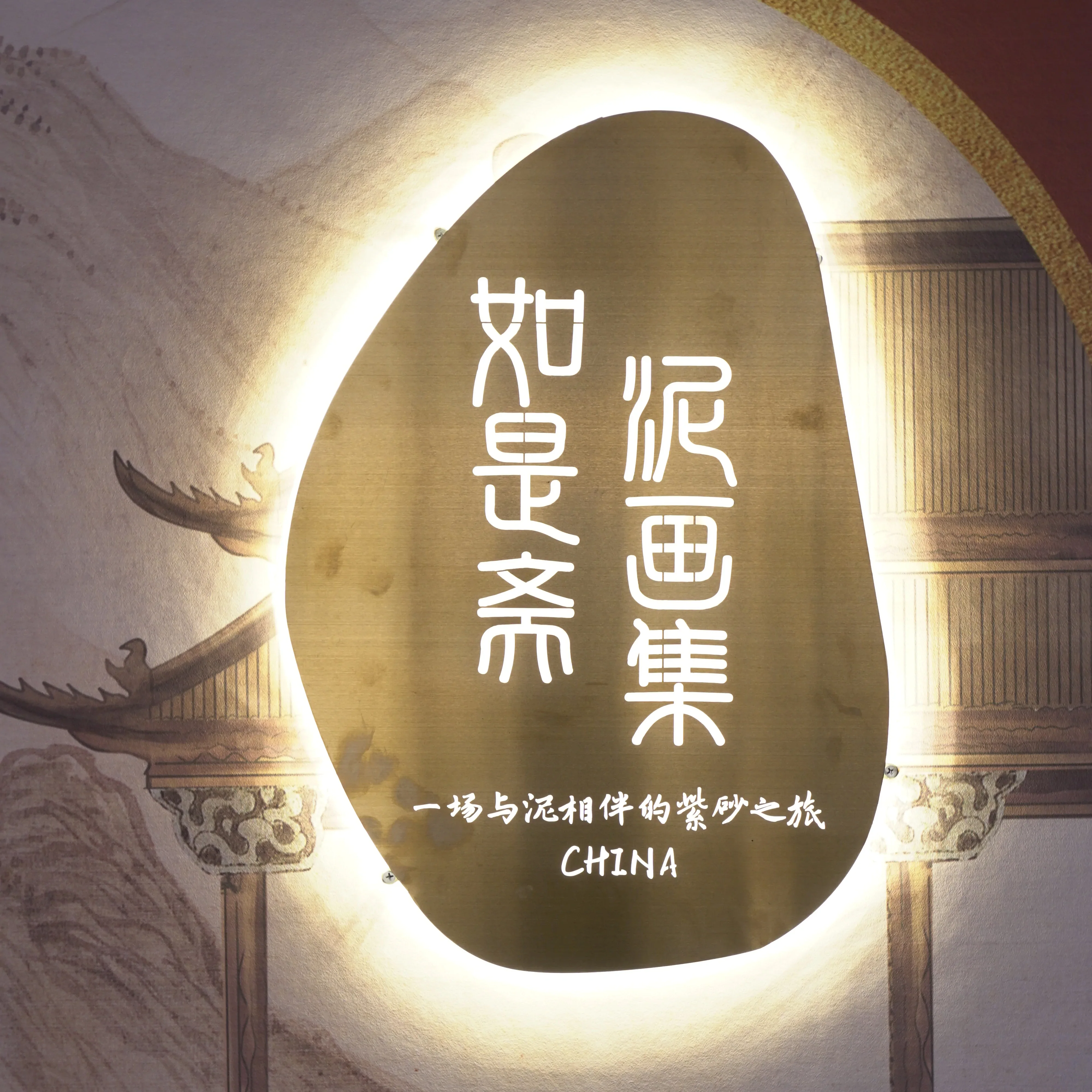
If you have an in-depth understanding of Zisha teapots, we accept full customization, and you can put forward your ideas from clay, vessel shape to pattern, but the price will fluctuate according to the complexity. If you just want a teapot just for you, we can engrave your name/logo on the teapot for you to make it unique. We can provide you with a certificate for free if you need it.Since all purple clay teapots need to be made on the spot, the preparation and production period is about 30 days, please know before placing an order.

lettering
You can engrave the exclusive mark you want on the pot

Pattern
You can propose the pattern you want, and the designer and master will customize the exclusive pattern for you
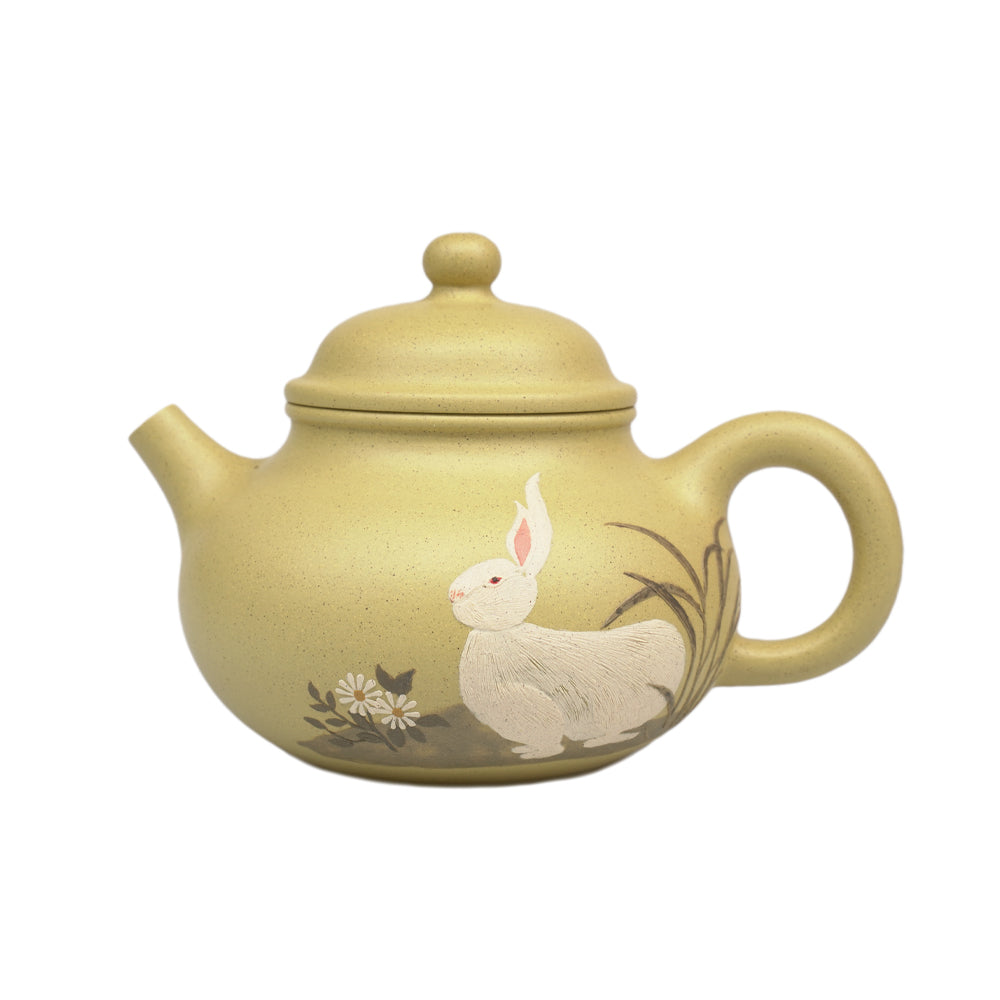
Zisha Mud
Different colors of mud for your choice
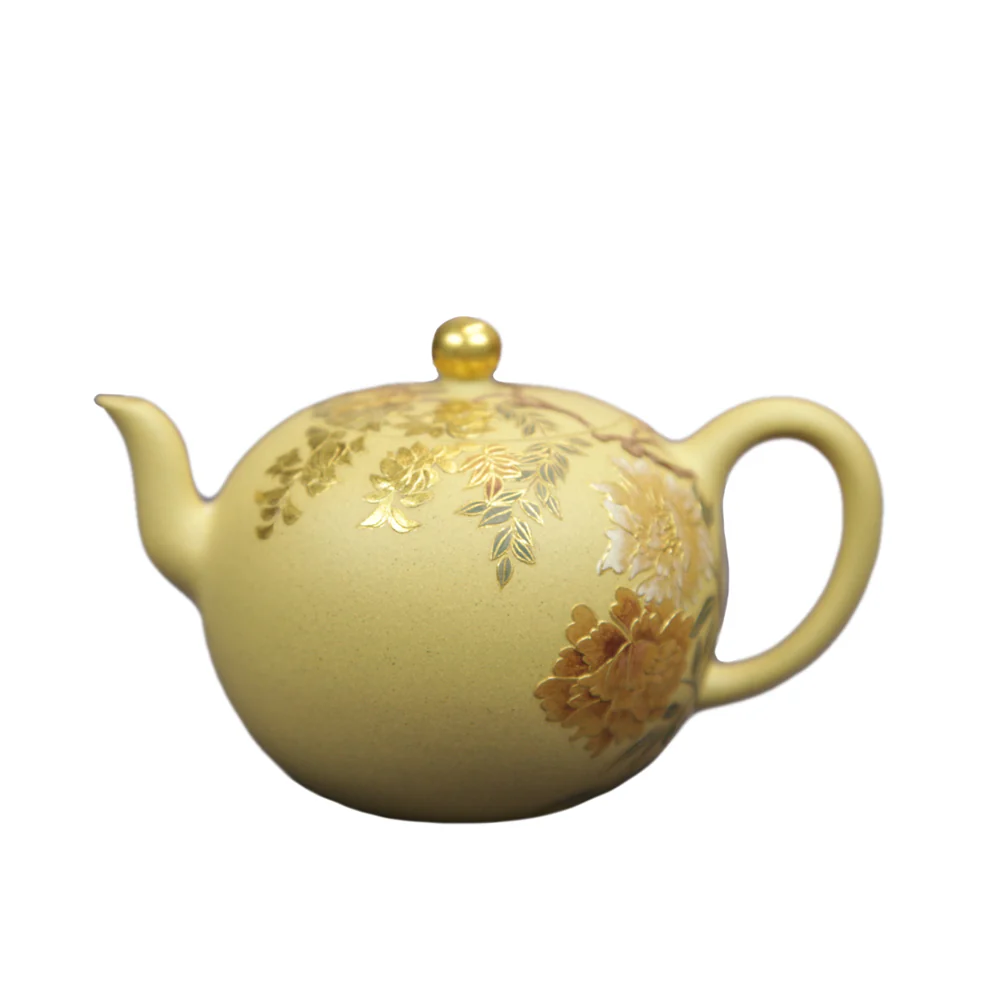
Type
Classic and modern teapots
Zisha teapot making process
The process of making a purple clay teapot is quite complicated and the process is very long.

1. Select zisha mud:
Cultivate the soil for half a year. Wash the hard lumpy mud excavated from the mine, put it in the open air to weather, smash it, remove the impurities in it, and then grind it and sieve it. Soak in water for more than half a year, take out the mud and beat it with a wooden hammer, cut into pieces and seal them, and store them in the kiln for later use
2. Draft the composition:
Determine the pot-shaped structure and draw the pattern
3. Kneading and molding:
There are many molding methods for purple sand, such as manual molding, grouting molding, drawing molding, machine molding and printing blank molding. First beat the mud into pieces, knead the body, then dig out the foot, open the surface, spread the shape of the pot evenly, and finally open the mouth hole, add the handle, mouth, cover, etc.
4. Trimming:
The surface of the purple clay teapot is not glazed, and the finished blank must be carefully trimmed to make the outline of the vessel full, with clear lines and clear texture, so as to meet the production requirements of round pearls and smooth jade, and integrate into a whole. Some utensils also need to be decorated .
5. Print the stamp:
The mouth of the pot faces down, and a small wooden post is used to strike a seal on the bottom of the pot.
6. Firing:
The blank should be dried in the shade for two or three days to remove the moisture in the embryo, otherwise it will be easy to burn and burst during firing. After drying in the shade, it is placed in a sagger and fired in a kiln.
7. Polishing and waxing:
Waxing is a unique process of Zisha. Painted purple clay wares need to be fired twice.
