
Left Continue shopping
Your Order

You have no items in your cart

You might like

The tea brewing guide

Brew your first cup of tea

Start with an ordinary cup. Learn how to adjust tea, water and steeping time, then try a filter cup, a gaiwan or a cold brew.
Tea poured from a glass pitcher into a small cup

Your first cup in three steps

  1. Measure Put 1–2 g of black or white loose-leaf tea in a cup.
  2. Pour Add 200–300 mL of water at the temperature suggested on the pack.
  3. Taste Try 3–5 minutes. Separate the leaves when the taste suits you.

Brew in a cup

1–2 g · 200–300 mL · 3–5 min for black or white tea

For a mug of black or white tea, add water at the temperature given on the package. Separate the leaves with a strainer or pour the liquor into another cup when the strength suits you.

As a starting point, put 2–4 g of green tea in a glass, add water at 85–90 °C and let the leaves unfurl for about 2–3 minutes. For a lighter cup, use less tea or shorten the steep. See the specific product’s brewing instructions for details.

For a milder cup of Longjing, try a shorter infusion of 1–2 minutes.

Tea cup for brewing loose leaves

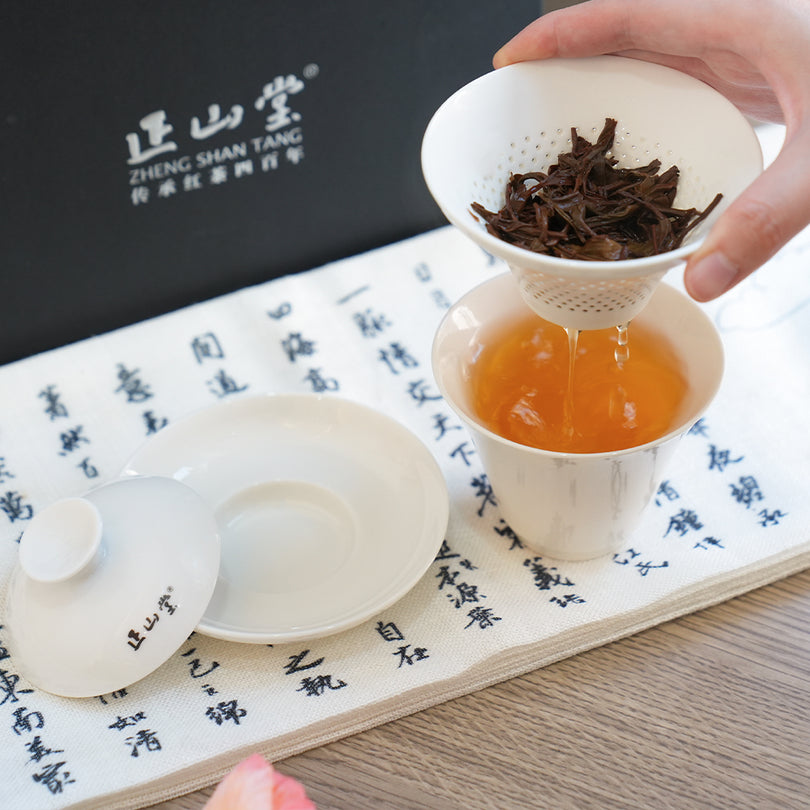
Use a filter cup

Start with 3–4 g of tea

Put the leaves in the removable filter. Add water at the temperature recommended for your tea. When it tastes right, lift the filter to separate the leaves.

Tea cup with a removable filter

Brew with a gaiwan

3–5 g · 120–150 mL gaiwan

For a small gaiwan, a traditional Chinese lidded bowl, start with 3–5 g of tea and water at 95–100 °C. Keep the first few infusions short, up to about 15 seconds each, and drain the tea completely after each pour. Adjust later infusions to taste. Follow the product’s brewing instructions for the best starting point for that tea and vessel.

For other teas in the same gaiwan, try these initial infusion times and water temperatures. Follow the product’s instructions when given.

  • Green tea 15–20 seconds · about 85 °C
  • Oolong tea 5–30 seconds · near boiling
  • Pu-erh tea 10–30 seconds · near boiling
Gaiwan and cups for short tea infusions

Cold brew in the fridge

Many of our teas can be cold-brewed. Add tea and drinking water to a clean, covered glass bottle or pitcher, then steep in the refrigerator. Keep it chilled. Check the specific product’s brewing instructions for the tea-to-water ratio and chilling time.

Bottle for cold-brew tea

Adjust one thing at a time

  • Tea amount Use a little less for a lighter cup or a little more for a fuller taste.
  • Water Start with water that tastes clean and use the temperature recommended for the tea.
  • Time Shorten the next steep if the cup tastes bitter or too strong. Give it a little longer if it tastes too light.

When the tea pack gives specific instructions, follow those first.

Watch how tea is brewed

Brew black tea in a gaiwan

Watch on YouTube

Use a cup with a removable filter

Watch on YouTube

Use a Yixing travel tea set

Watch on YouTube

Brew green tea or floral tea

Watch on YouTube

Watch a gongfu tea service

Watch on YouTube

Make a pear and hawthorn tea blend

Watch on YouTube

Longan and goji berries

Pair black tea with peeled, pitted longan and goji berries for a gently fruity cup.

Black tea with longan and goji berries

Hawthorn and apple

Pair black tea with fresh hawthorn and chopped apple for a fruity, lightly tart cup.

Black tea with hawthorn and apple

Rose and jasmine

Pair black tea with dried rose and jasmine sold for food or tea use. Add them to taste for a floral note.

Black tea with rose and jasmine

Red dates and ginger

Pair black tea with pitted dried red dates and sliced or shredded ginger for a gently spicy cup.

Black tea with red dates and ginger

Pear and dried tangerine peel

Pair black tea with pieces of peeled pear and dried tangerine peel for a mellow, citrus-scented cup.

Black tea with pear and dried tangerine peel

What to notice when tasting black tea

  • Dry leaves Look at their shape and colour.
  • Liquor Notice its clarity and shades of gold, orange or red.
  • Aroma and taste Smell the cup, then sip for sweetness, body and any floral, fruity or honey-like notes.
  • Infused leaves Look at how the leaves open and how their colour changes.
Black tea shown as dry leaves, brewed tea and infused leaves

Easy Steeper filter cup

A cup with a removable filter for brewing tea at home or at your desk.

Easy Steeper filter cup

Yixing clay travel tea set

A compact 160 mL set for brewing tea while travelling or at the office.

Yixing clay travel tea set

Three Fish hand-painted teaware

Hand-painted teaware for brewing with a gaiwan and sharing tea.

Three Fish hand-painted teaware

Brewing measurements and practical tea care

A gaiwan reference by tea type

Start with a 120–150 mL gaiwan and 3–5 g of loose leaf. Warm the gaiwan, drain it, add the leaf and smell it briefly. Pour, count the seconds, then empty the gaiwan so the tea does not continue to steep between rounds.

As starting points, try black tea at 95–100°C for 5–15 seconds, green tea around 85°C for 15–20 seconds, oolong at 95–100°C for 5–30 seconds and Pu’er at 95–100°C for 10–30 seconds. Delicate teas may prefer less heat. Taste the first round and change only one thing at a time. Later infusions can be lengthened as the flavour softens.

Cup, filter cup and cold infusion

For a 200–300 mL cup, try 1–2 g of tea. Delicate green tea can be tasted after 1–2 minutes; for a fuller cup try up to 3–5 minutes, depending on the leaf and your preference. Add water again while the flavour remains. A filter cup lets you lift the leaf when the tea reaches the strength you like. If you prefer a small teapot, try 1 g per 50 mL for black tea and 1 g per 20 mL for oolong as adjustable starting points.

For cold brew, use 1–2 g in 200–300 mL of cold drinking water, refrigerate at 0–4°C for 3–5 hours and strain. Green, black and white tea are all worth trying. Keep equipment clean, keep the brewed tea refrigerated and drink it promptly.

Short infusions or one longer cup

Gongfu brewing uses a small vessel and several short infusions. A fuller leaf-to-water ratio makes it possible to taste the same leaves as the fragrance, texture and finish change. Warm the vessel, smell the leaf, pour each round into a sharing pitcher or cups, and lengthen later rounds as needed.

A mug or larger teapot typically uses less leaf per volume and a longer infusion. It is useful when you want one cup at a time or a larger pot to share. The same Chinese tea can work with either method. Fresh drinking water, a suitable temperature and removing or draining the leaves on time matter more than the style of vessel.

Storing black tea and reading the classic tin

Keep black tea sealed in a cool, dry place, away from light, moisture and strong smells. Reseal it promptly after use, take it out with dry utensils and follow the storage directions and date on the particular pack. If the leaves have absorbed moisture or developed an unusual smell, do not judge them by the calendar alone.

Zheng Shan Tang’s classic tin uses a rigid tin-plated steel body to shade the leaf and protect it in transport. The inner seal and lid help limit moisture and outside odours. Depending on the edition, the base and lid, inner foil, origin or QR label, geographical indication and seals can provide clues when examining a pack. Compare the features with the official authentication guide for the same version.

A Jin Jun Mei tin photographed outdoors